Back to Library
The Astronaut's Desert Discovery: A Story of Patience
Preview
High Elementary (A2 High) CEFR A2

The Astronaut's Desert Discovery: A Story of Patience

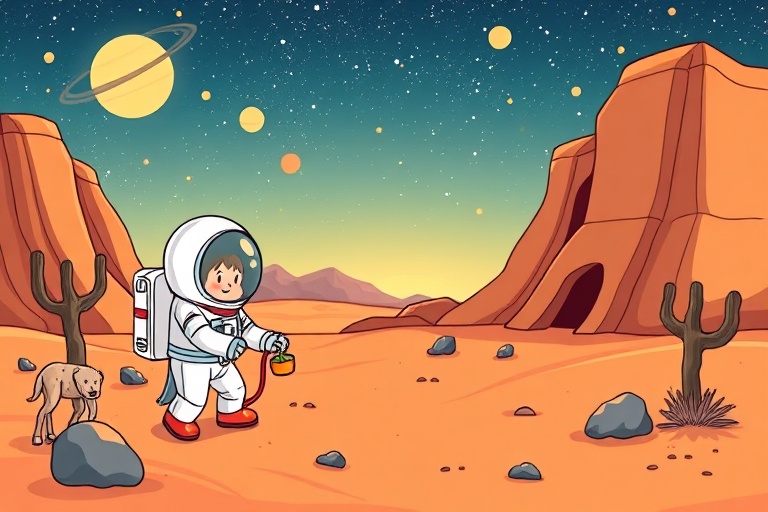
Astronaut Maya landed her small spacecraft in the middle of a vast desert. The desert looked like a golden savanna, but there were no animals in sight. She was on a mission to find out why the plants...

Duration

5 min read

Length

250 words

Story

4 paragraphs

Story Excerpt

Sample preview reading passage

Paragraphs 1–2 of 4

Astronaut Maya landed her small spacecraft in the middle of a vast desert. The desert looked like a golden savanna, but there were no animals in sight. She was on a mission to find out why the plants were disappearing. The sun was hot, and the wind was dry, but Maya stayed calm. She knew that patience would help her solve the mystery.

Maya walked slowly across the sand, looking for clues. She saw small holes in the ground, which were made by tiny insects. Nearby, she found a dry riverbed that had no water. She realized that a long drought had changed the land. Without rain, the grass could not grow, so the animals had to move to find food. This was the start of a great migration.

Enjoying the preview?

Sign in to read the full story, track your progress, and earn rewards.

Complete Story & Ending Interactive Vocabulary & Quizzes Track Reading Streak & XP
Educational Objectives

Story Details

Grammar focus and learning objectives covered in this story.

Grammar Level

A2 · Past Simple, relative clauses, modal verbs

Learning Outcomes

  • read and understand a short story about an astronaut in a desert
  • recognise and use past simple verbs to talk about past events
  • identify the food chain in a savanna ecosystem
  • use new vocabulary words like savanna, predator, graze, migration, drought
  • answer comprehension questions about the story

Grammar Focus

Past Simple: subject + verb(-ed) for regular verbs, or irregular forms

We use the past simple to talk about actions that started and finished in the past. It is often used in stories to tell what happened.

“ Astronaut Maya landed her small spacecraft in the middle of a vast desert.
Tip: Remember that many common verbs are irregular, like 'saw' and 'found'. Practice their past forms.
Relative Clauses: who, which, that

We use relative clauses to give more information about a person or thing. 'Who' is for people, 'which' for things, and 'that' for both.

“ She saw small holes in the ground, which were made by tiny insects.
Tip: Make sure the relative pronoun agrees with the noun it describes. Use commas for extra information.
Modal Verbs: could, had to

We use 'could' to talk about ability or possibility in the past, and 'had to' to talk about necessity in the past.

“ Without rain, the grass could not grow, so the animals had to move to find food.
Tip: Use 'could' for things that were possible, and 'had to' for things that were necessary.

Reading tip

Daily Habit

Pick stories slightly below your level. Understanding about 95% of the words keeps reading enjoyable and effective.

Create a free account and turn this tip into a daily habit — full stories, quizzes, and progress tracking included.

More Stories to Read

Explore other popular stories from our reading library.

View all