Back to Library
The Mermaid in the Giant Treehouse: A Chess Match of Courage
Preview
High Intermediate (B1 High) CEFR B1

The Mermaid in the Giant Treehouse: A Chess Match of Courage

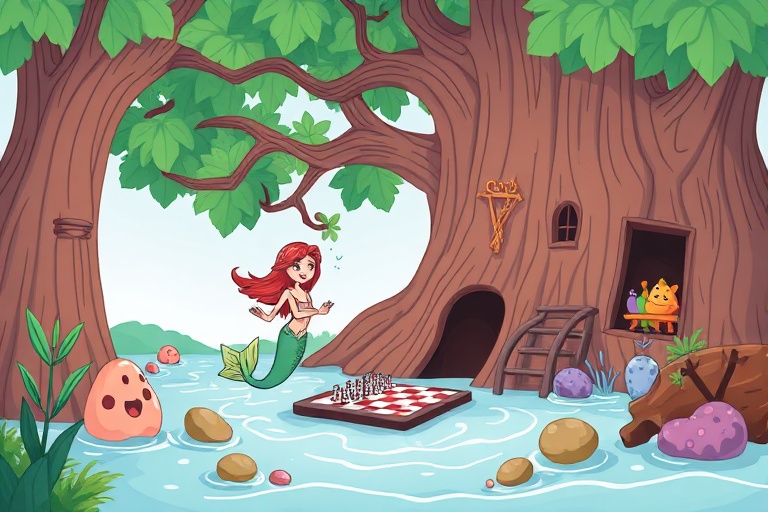
Nerida had always lived in the giant treehouse that her grandfather had built in the heart of the kelp forest. The treehouse was not made of wood, but of woven sea grass and polished shells that glowe...

Duration

5 min read

Length

347 words

Story

5 paragraphs

Story Excerpt

Sample preview reading passage

Paragraphs 1–2 of 5

Nerida had always lived in the giant treehouse that her grandfather had built in the heart of the kelp forest. The treehouse was not made of wood, but of woven sea grass and polished shells that glowed softly in the dim ocean light. However, Nerida rarely left its safe branches, because she was afraid of the open water beyond. Her only companion was a small, wise octopus named Cephalos, who often watched her play chess on a barnacle-covered board.

One evening, as Nerida moved her knight, Cephalos said, "Your brain is the control center of your body, just like the queen controls the chessboard." Nerida paused, her fingers hovering over a pawn. "Every time you plan a move, millions of neurons send signals through your nerves," Cephalos continued. "These signals travel from your brain to your hand, and back again, helping you coordinate your thoughts and actions." Nerida had never thought about her own brain before, but now she imagined tiny messengers racing inside her.


Enjoying the preview?

Sign in to read the full story, track your progress, and earn rewards.

Complete Story & Ending Interactive Vocabulary & Quizzes Track Reading Streak & XP
Educational Objectives

Story Details

Grammar focus and learning objectives covered in this story.

Grammar Level

B1 · Present Perfect, First Conditional, Past Simple

Learning Outcomes

  • Read a story about a mermaid and identify how the brain and nerves work.
  • Use present perfect and first conditional sentences to talk about experiences and possibilities.
  • Recognise and use target vocabulary: neuron, signal, control, memory, coordinate.
  • Answer comprehension questions about the story's plot and moral.
  • Explain in simple terms how to keep the brain sharp and healthy.

Grammar Focus

Present Perfect: subject + have/has + past participle

We use the present perfect to talk about experiences or states that started in the past and continue to the present, or that have relevance now.

“ Nerida had always lived in the giant treehouse that her grandfather had built in the heart of the kelp forest.
Tip: Use 'since' for a starting point and 'for' for a duration with the present perfect.
Conditional Type 1: If + present simple, will + base verb

We use the first conditional to talk about real or possible situations in the future and their likely results.

“ If I go out there, I might get lost or hurt.
Tip: Remember that the if-clause uses the present simple, not 'will'.
Past Simple: subject + verb-ed / irregular past

We use the past simple to describe completed actions or events in the past.

“ She took a deep breath and swam forward, coordinating her tail and arms.
Tip: For regular verbs, add -ed; for irregular verbs, learn the past form by heart.

Reading tip

Daily Habit

Don’t stop at every unknown word. Guess the meaning from context first, then check — that is how fluent readers build intuition.

Create a free account and turn this tip into a daily habit — full stories, quizzes, and progress tracking included.

More Stories to Read

Explore other popular stories from our reading library.

View all