Back to Library
The Dolphin of the Desert Oasis: A Tale of Being Yourself
Preview
High Intermediate (B1 High) CEFR B1

The Dolphin of the Desert Oasis: A Tale of Being Yourself

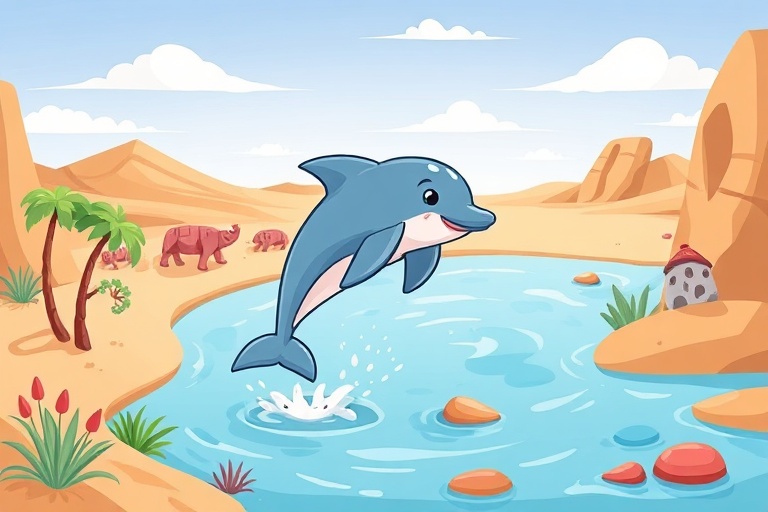
In the heart of the vast desert, there was a magical oasis called Zephyria, where a young dolphin named Kael lived among golden dunes and sparkling water. However, Kael had always felt out of place be...

Duration

5 min read

Length

400 words

Story

5 paragraphs

Story Excerpt

Sample preview reading passage

Paragraphs 1–2 of 5

In the heart of the vast desert, there was a magical oasis called Zephyria, where a young dolphin named Kael lived among golden dunes and sparkling water. However, Kael had always felt out of place because dolphins were supposed to live in the ocean, not in a desert. Every day, he watched the other animals—camels, lizards, and desert foxes—and wished he could be like them. Yet, deep inside, he knew that his unique abilities might be the key to saving the kingdom from an ancient curse.

The kingdom of Zephyria was protected by a mystical pearl that kept the oasis alive, but one day the pearl lost its glow, and the waters began to shrink. The wise old tortoise, Elder Shell, explained that the pearl needed a special signal from a creature who could coordinate the brain's control center with the heart's courage. "Only a dolphin's sonar can send the right neuron messages to restore the pearl," she said. Kael realized that his difference was not a weakness but a gift. Therefore, he decided to embark on a journey to the Crystal Caves, where the pearl's power source lay hidden.


Enjoying the preview?

Sign in to read the full story, track your progress, and earn rewards.

Complete Story & Ending Interactive Vocabulary & Quizzes Track Reading Streak & XP
Educational Objectives

Story Details

Grammar focus and learning objectives covered in this story.

Grammar Level

B1 · Present Perfect, Second Conditional, Passive Voice

Learning Outcomes

  • Recognise and use the present perfect to describe experiences and ongoing states.
  • Form second conditional sentences to talk about imaginary situations.
  • Identify passive voice constructions and understand their purpose.
  • Use target vocabulary such as neuron, signal, control, memory, and coordinate in context.
  • Explain how the brain and nerves work together to control the body.

Grammar Focus

Present Perfect: subject + have/has + past participle

Use the present perfect to talk about experiences or states that started in the past and continue to the present, or when the exact time is not important.

“ Kael had always felt out of place because dolphins were supposed to live in the ocean, not in a desert.
Tip: Remember that 'always' and 'never' often go with the present perfect to emphasize duration or lack of experience.
Second Conditional: if + past simple, would + base verb

Use the second conditional to imagine unreal or hypothetical situations in the present or future.

“ If it hadn't rained earlier, the park would have been crowded.
Tip: In the if-clause, use 'were' instead of 'was' for all subjects in formal English (e.g., 'If I were you').
Passive Voice: subject + be + past participle

Use the passive voice when the focus is on the action or the receiver of the action, rather than the doer.

“ The kingdom of Zephyria was protected by a mystical pearl that kept the oasis alive.
Tip: Only use the passive when the doer is unknown, unimportant, or obvious from context.

Reading tip

Daily Habit

Say new words out loud or use them in your own sentence — actively using a word moves it into lasting memory.

Create a free account and turn this tip into a daily habit — full stories, quizzes, and progress tracking included.

More Stories to Read

Explore other popular stories from our reading library.

View all