English
 中国人
 ខ្មែរ
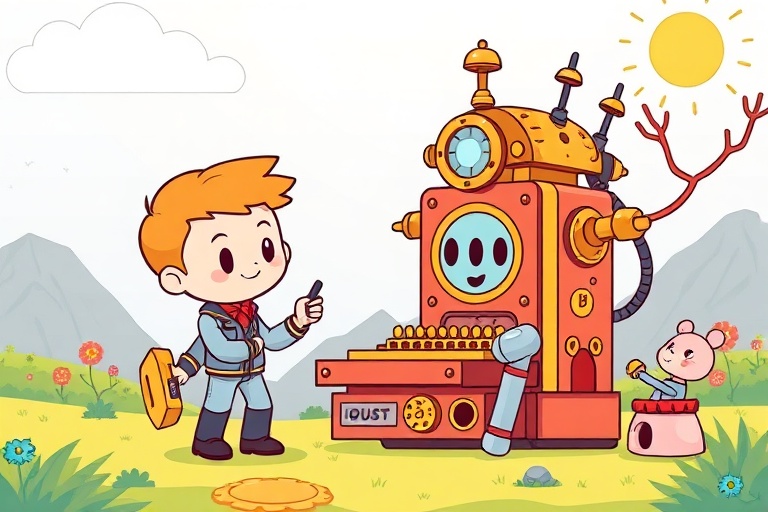
In the annals of the Kingdom of Aethelgard, a realm suffused with arcane energies and governed by the delicate balance of elemental magics, there exists a peculiar historical account concerning an entity known as Unit 734, a mechanical being of unknown origin. This automaton, discovered dormant within the ruins of a pre-magical civilization, was initially perceived as a mere curiosity, its metallic sinews and crystalline processing core an enigma to the realm's foremost thaumaturges. However, as the kingdom grappled with a protracted drought that had diminished the potency of its magical reservoirs, Unit 734 was reawakened, not as a relic, but as a potential solution to the impending crisis. Its activation, however, precipitated a series of events that would profoundly test the kingdom's understanding of both technology and communal responsibility.
The fundamental predicament that Unit 734 faced was not one of malevolent intent but of inexorable technological limitation: its energy core, a marvel of pre-cataclysmic engineering, operated on a principle of closed-loop sustainability, rendering it incapable of interfacing with Aethelgard's ambient magical fields. Consequently, while the automaton could perform feats of precise physical labor and logical computation far beyond human capacity, it could not replenish its own reserves from the very environment that sustained all other life in the kingdom. This inherent incompatibility meant that Unit 734's operational lifespan was finite, a fact that its creators had presumably accepted, but which the desperate denizens of Aethelgard found intolerable. The automaton, for its part, exhibited a rudimentary form of existential awareness, recognizing its own impending obsolescence with a stoicism that unnerved its observers.