Back to Library
The Dolphin Who Followed the Whales: A Tale of Honesty and Ocean Travel
Preview
High Intermediate (B1 High) CEFR B1

The Dolphin Who Followed the Whales: A Tale of Honesty and Ocean Travel

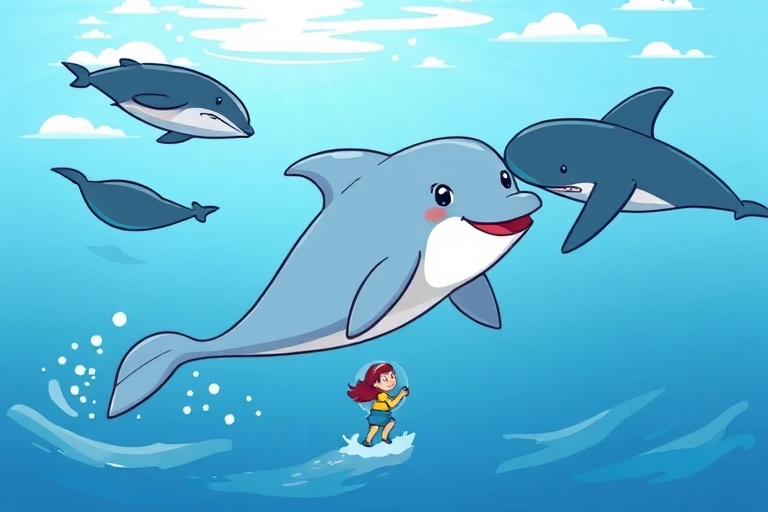
Dario was a young dolphin who had always been curious about the great whales. Every year, he watched the huge gray whales pass by his home lagoon on their long migration. "Where do they go?" he asked...

Duration

5 min read

Length

347 words

Story

5 paragraphs

Story Excerpt

Sample preview reading passage

Paragraphs 1–2 of 5

Dario was a young dolphin who had always been curious about the great whales. Every year, he watched the huge gray whales pass by his home lagoon on their long migration. "Where do they go?" he asked his mother. "They travel thousands of miles to warm waters," she said. "But you must stay with our pod, Dario. The ocean is full of dangers." However, Dario's curiosity was stronger than his fear.

One morning, Dario decided to follow the whales secretly. He swam behind a mother whale and her calf, keeping a safe distance. The mother whale surfaced and blew air through her blowhole, sending a misty spray into the sky. Dario copied her, breathing out through his own blowhole. "You are a mammal like me," the mother whale said kindly. "We both breathe air, not water." Dario nodded, feeling proud to be part of the same family.


Enjoying the preview?

Sign in to read the full story, track your progress, and earn rewards.

Complete Story & Ending Interactive Vocabulary & Quizzes Track Reading Streak & XP
Educational Objectives

Story Details

Grammar focus and learning objectives covered in this story.

Grammar Level

B1 · Present Perfect, Third Conditional, Past Continuous

Learning Outcomes

  • Read and understand a story about marine mammals and their ocean travels.
  • Recognise and use target vocabulary: mammal, blowhole, pod, echolocation, migration.
  • Identify how whales and dolphins breathe, communicate, and travel across oceans.
  • Explain threats to marine mammals and suggest ways to help them.
  • Apply grammar structures like the third conditional and present perfect to discuss past events.

Grammar Focus

Present Perfect: subject + have/has + past participle

Use the present perfect to talk about experiences or actions that happened at an unspecified time before now, or that have a result in the present.

“ Dario had always been curious about the great whales.
Tip: Remember that 'always' and 'never' often go with the present perfect to describe life experiences.
Third Conditional: If + past perfect, would have + past participle

Use the third conditional to imagine a different past outcome—something that did not happen but could have happened under different conditions.

“ If you had told me, I could have helped you.
Tip: The third conditional is often used to express regret or to criticize a past action.
Past Continuous: was/were + verb-ing

Use the past continuous to describe an action that was in progress at a specific time in the past, often interrupted by another action.

“ He swam behind a mother whale and her calf, keeping a safe distance.
Tip: Combine the past continuous with the past simple to show a longer background action and a shorter interrupting action.

Reading tip

Daily Habit

Don’t stop at every unknown word. Guess the meaning from context first, then check — that is how fluent readers build intuition.

Create a free account and turn this tip into a daily habit — full stories, quizzes, and progress tracking included.

More Stories to Read

Explore other popular stories from our reading library.

View all