Back to Library
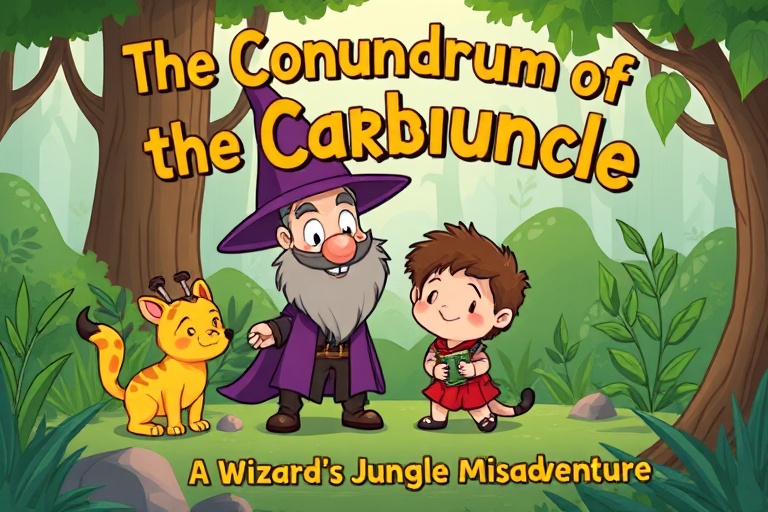
The Conundrum of the Carbuncle: A Wizard's Jungle Misadventure
Preview
Proficient (C2 Low) Academic CEFR C2

The Conundrum of the Carbuncle: A Wizard's Jungle Misadventure

Archibald Pimpernel, a wizard whose mastery of the arcane was matched only by his profound ineptitude in the mundane, found himself inexplicably deposited in a jungle that predated the very concept of...

Duration

5 min read

Length

1,012 words

Story

9 paragraphs

Story Excerpt

Sample preview reading passage

Paragraphs 1–2 of 9

Archibald Pimpernel, a wizard whose mastery of the arcane was matched only by his profound ineptitude in the mundane, found himself inexplicably deposited in a jungle that predated the very concept of trousers. The air, thick with the scent of primordial rot and overripe fruit, was punctuated by the guttural roars of creatures that had clearly skipped the memo on extinction. His mission, should he choose to accept it (and he had no choice, as his teleportation spell had misfired spectacularly), was to retrieve the fabled Carbuncle of Clarity, a gem purported to grant its possessor unerring insight into any mystery. Unfortunately, the only clue he had was a cryptic note that read, 'Beware the one who squawks in iambic pentameter,' which was about as helpful as a chocolate teapot in a heatwave.

His first encounter was with a velociraptor that, instead of rending him limb from limb, fixed him with a beady eye and demanded, in a clipped Oxford accent, 'Pray tell, good sir, have you a permit for that rather ostentatious wand?' Archibald, flummoxed, stammered something about a magical mishap, but the raptor merely clicked its claws in annoyance and stalked off, muttering about bureaucratic inefficiencies. This set the tone for his entire expedition: every dinosaur he met seemed less interested in devouring him and more concerned with arcane trivia or the proper etiquette for a trilobite tea party. A stegosaurus with a monocle lamented the poor state of fern cultivation, while a pterodactyl dive-bombed him, shrieking critiques of his pronunciation of ancient Sumerian.


Enjoying the preview?

Sign in to read the full story, track your progress, and earn rewards.

Complete Story & Ending Interactive Vocabulary & Quizzes Track Reading Streak & XP
Educational Objectives

Story Details

Grammar focus and learning objectives covered in this story.

Grammar Level

C2 · Past Perfect, Third Conditional, Inversion

Learning Outcomes

  • Recognise and use the past perfect to sequence past events in narratives.
  • Form and apply third conditional sentences to discuss hypothetical past scenarios.
  • Use inversion with 'Not only ... but also' for emphasis in formal writing.
  • Understand and interpret complex narrative structures and advanced vocabulary in context.
  • Analyse how grammatical choices enhance storytelling and character development.

Grammar Focus

Past Perfect Simple: had + past participle

Use the past perfect to describe an action that happened before another past action or time. It clarifies the order of events in the past.

“ His mission, should he choose to accept it (and he had no choice, as his teleportation spell had misfired spectacularly), was to retrieve the fabled Carbuncle of Clarity...
Tip: Use the past perfect when you need to show that one past event occurred before another. It often appears with time expressions like 'before', 'after', or 'by the time'.
Third Conditional: If + past perfect, would have + past participle

Use the third conditional to talk about hypothetical situations in the past that did not happen and their imagined results. It expresses regret, criticism, or unreal past conditions.

“ If he had known the answer, he would have solved the riddle immediately.
Tip: Remember that the if-clause uses the past perfect, and the main clause uses 'would have' + past participle. This structure is common in expressing missed opportunities or alternative outcomes.
Inversion with 'Not only ... but also': Not only + auxiliary + subject + verb, but also ...

Use this inverted structure for emphasis, especially in formal or literary contexts. It highlights two related points, with the first clause inverted for dramatic effect.

“ Not only did he solve the riddle, but he also learned the value of teamwork.
Tip: When you start a sentence with 'Not only', invert the subject and auxiliary verb in that clause. The second clause with 'but also' follows normal word order.

Reading tip

Daily Habit

Say new words out loud or use them in your own sentence — actively using a word moves it into lasting memory.

Create a free account and turn this tip into a daily habit — full stories, quizzes, and progress tracking included.

More Stories to Read

Explore other popular stories from our reading library.

View all