Back to Library
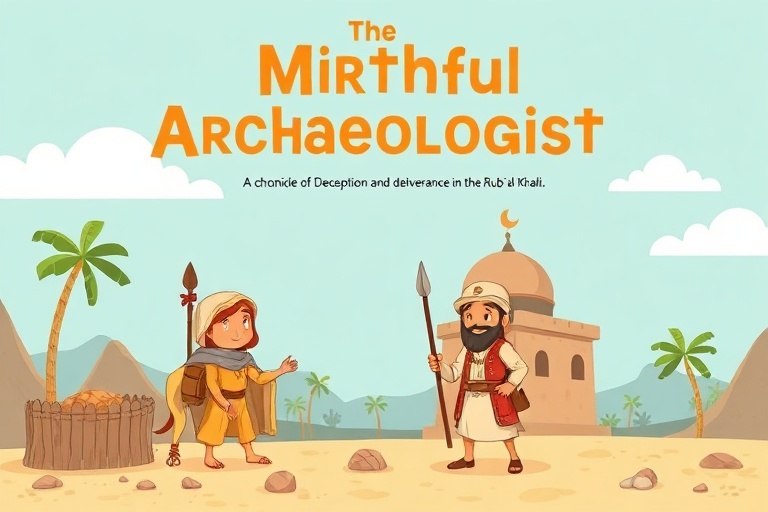
The Mirthful Archaeologist: A Chronicle of Deception and Deliverance in the Rub' al Khali
Preview
Proficient (C2 Low) Academic CEFR C2

The Mirthful Archaeologist: A Chronicle of Deception and Deliverance in the Rub' al Khali

Dr. Alistair Grimble, a man whose academic reputation rested precariously on a single, unverified hypothesis, stood at the precipice of the Rub' al Khali, squinting through the heat-haze at the undula...

Duration

5 min read

Length

1,082 words

Story

9 paragraphs

Story Excerpt

Sample preview reading passage

Paragraphs 1–2 of 9

Dr. Alistair Grimble, a man whose academic reputation rested precariously on a single, unverified hypothesis, stood at the precipice of the Rub' al Khali, squinting through the heat-haze at the undulating dunes that stretched to eternity. His theory, audaciously posited in a much-derided monograph, asserted that a pre-Islamic civilization had domesticated the oryx for milk and transport, a claim that had earned him the sobriquet 'The Lactose Lunatic' among his peers. Funded by a grant from a foundation whose name he could never quite remember, he had assembled a ragtag team of Bedouin guides and a skeptical graduate student named Farid, whose perpetual smirk suggested he was cataloguing Alistair's every misstep for a future dissertation on academic hubris. The expedition's objective was simple: unearth the fossilized remains of a milking stool, which Alistair insisted would vindicate him and silence his detractors forever.

The first weeks yielded nothing but sunburn, sand fleas, and a growing sense of futility that gnawed at Alistair's resolve like a persistent rodent. Each morning, he would dispatch Farid and the guides to excavate a promising site, only to be greeted hours later with shrugs and the ubiquitous phrase, 'Nothing but sand, Doctor.' His hypothesis, once a gleaming edifice of logical deduction, began to crumble under the weight of empirical indifference, and he found himself staring at his own published diagrams with the dawning horror of a man who has bet his career on a mirage. Farid, ever the pragmatist, suggested that perhaps the oryx had been hunted, not herded, but Alistair dismissed this as the defeatist prattle of a mind unaccustomed to visionary thinking. The desert, indifferent to human ambition, offered no counsel.


Enjoying the preview?

Sign in to read the full story, track your progress, and earn rewards.

Complete Story & Ending Interactive Vocabulary & Quizzes Track Reading Streak & XP
Educational Objectives

Story Details

Grammar focus and learning objectives covered in this story.

Grammar Level

C2 · Past Perfect Continuous, Third Conditional, Inversion for emphasis

Learning Outcomes

  • Recognize and interpret the use of Past Perfect Continuous to describe ongoing past actions.
  • Analyze the Third Conditional to discuss hypothetical past scenarios and their consequences.
  • Identify and understand inverted structures used for emphasis in formal academic writing.
  • Evaluate the moral dilemma presented in the story and articulate the importance of honesty in research.
  • Infer the author's objective tone and the satirical elements that critique academic ambition.

Grammar Focus

Past Perfect Continuous: subject + had been + present participle

This tense describes an action that was ongoing in the past up until another past event or time. It emphasizes the duration or continuous nature of the earlier action.

“ He had been blinded by ambition.
Tip: Use it to show cause or background for a later past situation, often with 'because' or 'so'.
Third Conditional: If + past perfect, would have + past participle

This structure expresses a hypothetical situation in the past that did not happen, and its imagined result. It is often used for regret or speculation.

“ To deceive now would be to render meaningless every genuine insight he had ever pursued.
Tip: Remember that both clauses refer to the past; the 'if' clause uses past perfect, and the main clause uses 'would have' + past participle.
Inversion for emphasis: Negative adverbial + auxiliary verb + subject + main verb

When a negative or restrictive adverbial (e.g., 'not only', 'rarely', 'never') is placed at the beginning of a sentence, the subject and auxiliary verb are inverted for formal emphasis.

“ Not only did he admit his error, but he also embraced the lesson.
Tip: Use this structure sparingly in formal writing to highlight a surprising or important point.

Reading tip

Daily Habit

Re-read a story you enjoyed. Each pass deepens comprehension and helps new words stick in long-term memory.

Create a free account and turn this tip into a daily habit — full stories, quizzes, and progress tracking included.

More Stories to Read

Explore other popular stories from our reading library.

View all